Find Treatment By
Rehabs by Location


Find Treatment By
Learn
About Us
Recovery.com combines independent research with expert guidance on addiction and mental health treatment. Our mission is to help everyone find the best path to recovery through the most comprehensive, helpful network of treatment providers worldwide.
Advisory Council
Our advisory council brings together leaders in behavioral health, technology, and business. Their diverse expertise ensures our resources and product are innovative, evidence-based, and effective. They guide our mission as accomplished individuals dedicated to improving the landscape of addiction recovery and mental wellness.
Counting Sobriety Days: Benefits, Drawbacks, and How to Decide

April Wilson Smith, MPH, is a PhD student in Population Health at Thomas Jefferson University in Philadelphia. Her research focuses on harm reduction approaches to people who use substances when they enter the healthcare system.
April Wilson Smith, MPH, is a PhD student in Population Health at Thomas Jefferson University in Philadelphia. Her research focuses on harm reduction approaches to people who use substances when they enter the healthcare system.
- Counting sobriety days can motivate some people by providing a tangible measure of progress, but it may cause distress for others if a slip triggers shame or fear of losing time.
- Relapse rates for substance use disorders are similar to other chronic health conditions, which means slips are common and don't necessarily "erase" recovery progress.
- Recovery programs differ in how they view slips: some require restarting day counts, while others treat slips as learning opportunities without resetting progress.
- Whether to count sobriety days is a personal choice that should support your well-being, not create additional pressure or shame.
Table of Contents
- What Is a Sobriety Date?
- Why Counting Counts
- But What Happens When You Slip?
- How Other Recovery Programs View Day Counting
- How 12-Step Programs View Slips
- What Research Says About Recovery and Drinking
- When Does Counting Help, and When Does It Hurt?
- Alternative Ways to Track Recovery Progress
- So, Should I Count?
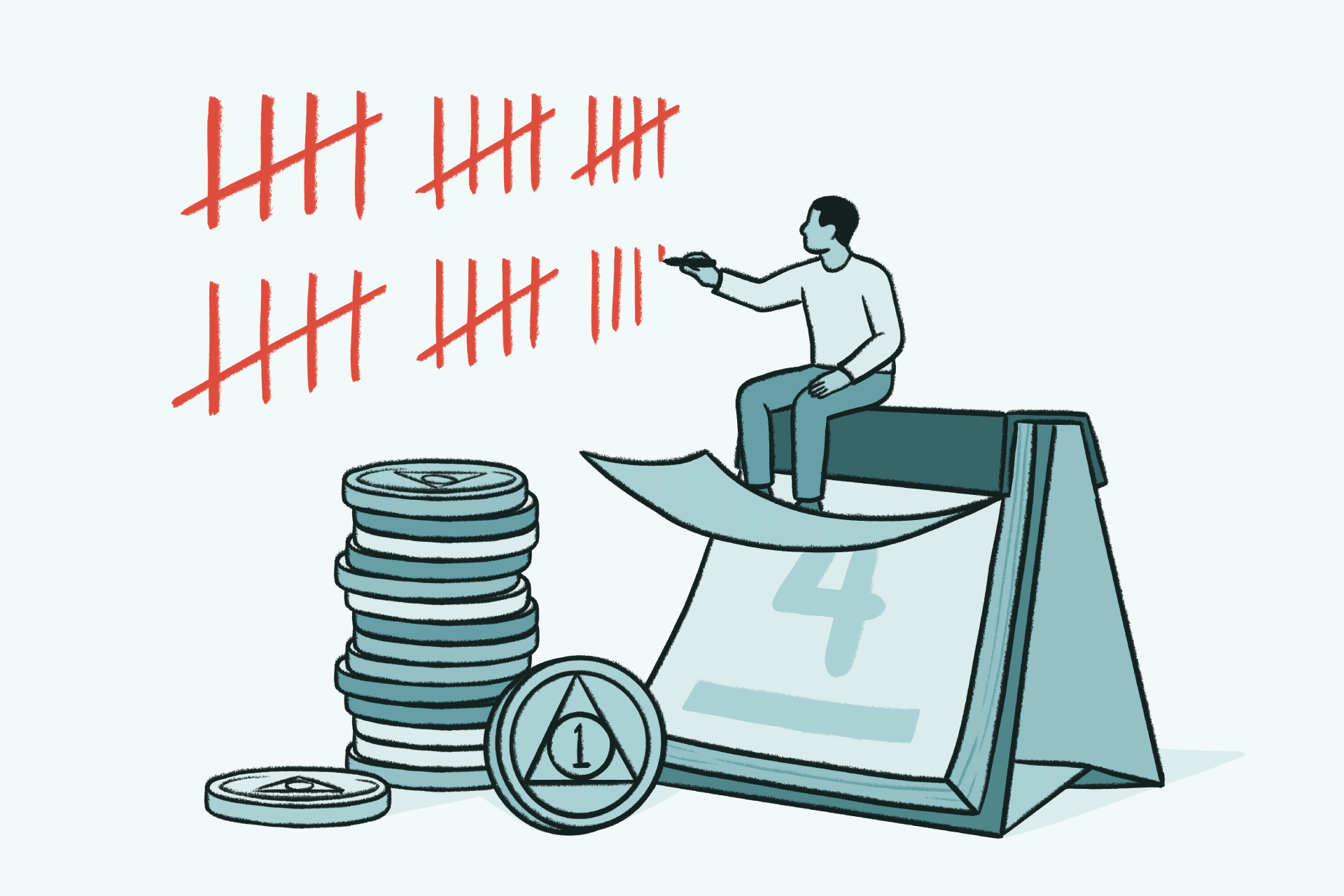
For many people, a sobriety date is more than just a number on an app. It can be a private reminder of how far you've come, a milestone shared in meetings, or a way to stay focused one day at a time.
In some recovery communities, such as Alcoholics Anonymous (AA), people introduce themselves with their sobriety date and celebrate 30, 60, or 90 days with coins and recognition from the group.
At the same time, recovery looks different for everyone. Some people find day counting deeply motivating. Others feel it creates pressure, especially if they experience a return to substance use. Questions about FDA-approved medications that can help people stop using certain substances can also complicate how people think about progress.
This article explores the benefits, drawbacks, and alternatives to counting days so you can decide whether it supports your recovery goals.

What Is a Sobriety Date?
A sobriety date marks the start of your recovery. For some people, this is the last day they used alcohol or other drugs. For others, it's the first full day after they stopped. Both approaches are common, and neither is more correct than the other. What matters most is that the date feels clear and meaningful to you.
Some peer support groups, treatment programs, or workplaces may define it more specifically, especially if they require continuous abstinence. Outside of those settings, though, a sobriety date is usually a personal milestone.
People track that milestone in different ways. Some use a phone app or sobriety calculator. Others mark a calendar, keep a journal, or collect milestone coins. The National Institute on Drug Abuse (NIDA) notes that recovery is an ongoing process that can include different forms of support over time.1 This means if your definition of recovery changes over time, the way you track progress may change too.
Why Counting Counts
The reasons people count sobriety days vary, but one of the most common is that it provides something concrete to build on. Recovery can feel abstract, especially in the early days, and a running total can make progress visible. Watching the days add up can create a sense of momentum. That kind of positive reinforcement can make it easier to keep doing the things that support your goals.
Counting can also strengthen social support. Milestones like 30, 60, or 90 days often give friends, sponsors, or support groups a chance to celebrate with you. For some people, that recognition matters.
There are practical reasons to count, too. Some jobs, especially in the treatment field, may ask for a certain length of abstinence or recovery time. On some treatment center websites, you may see language like: “If in recovery, two years of continuous sobriety preferred.” In those situations, a sobriety date can function almost like a credential.
Still, counting works best when it supports your own motivation. If you're counting because it helps you stay focused, it may be helpful. If you're counting only because someone else expects it, the pressure may outweigh the benefit.
Explore Drug Addiction Treatment Centers
But What Happens When You Slip?
Slips can be common. The National Institute on Drug Abuse (NIDA) notes that relapse rates for substance use disorders range from 40% to 60%, which is similar to rates for other chronic conditions like asthma and hypertension.1 A return to substance use doesn't mean treatment has failed. Instead, it may signal that you need more support.
Different recovery communities may also define a “slip” differently. For example, SMART Recovery distinguishes between a slip and a relapse. A slip is a brief return to use, while a relapse is a fuller return to problematic patterns with harmful consequences.2 That distinction matters because it can shape how people respond. If you treat one drink or one impulsive decision as a total failure, you may be more likely to keep going rather than pause and regroup.
This pattern is part of what researchers Alan Marlatt and Judith Gordon called the Abstinence Violation Effect.3 In simple terms, it describes the feeling that after a lapse, you’ve already “blown it,” so there’s no point trying to stop. Shame can turn a small setback into a bigger one. A more helpful response may be to ask: What triggered this? What support was missing? What might help me make a different choice next time?
That doesn’t mean slips are trivial. They can be serious and deserve attention. But they don’t erase the progress you’ve already made.
If you're navigating the challenges of relapse or worried about returning to old patterns, this video offers practical insight into why relapse happens and how to prevent it:
How Other Recovery Programs View Day Counting
Some recovery programs take a more flexible approach to day counting. SMART Recovery, for example, teaches people how to interrupt a slip before it becomes a full relapse and encourages them to learn from setbacks rather than define themselves by them.2 That can make counting feel less like a pass-fail test and more like one tool among many.
Tom Horvath, PhD—founder of Practical Recovery and former president of SMART Recovery for 20 years—explains that many participants still track time in recovery, but in more individualized ways:

Other recovery groups go further in emphasizing personal choice. Kenneth Anderson, MA, founder and executive director of Harm Reduction, Abstinence and Moderation Support (HAMS), leads an international organization that supports different goals, including abstinence, moderation, and safer drinking.

For some people, this flexibility is a relief. It leaves room for recovery goals that are personal, evolving, and not always defined by a single streak.
How 12-Step Programs View Slips
12-Step programs often take a stricter view of slips. In Alcoholics Anonymous (AA), many members treat any drinking as a relapse and reset their sobriety date. From that perspective, the issue isn’t just how much a person drank, but that they crossed a line they had committed not to cross. Resetting the count is meant to support honesty, humility, and renewed focus.
For people who find structure helpful, that clarity can be reassuring. A sobriety date reflects continuous abstinence, and a slip means starting again. It can also make shared milestones easier to celebrate because everyone is using roughly the same measure.
At the same time, 12-Step culture isn’t completely uniform. AA has no central authority monitoring each person’s day count, and members sometimes differ in how they interpret situations that fall outside straightforward alcohol or drug use. Questions can come up, for example, around prescribed medications or mental health treatment. The AA pamphlet The AA Member: Medications and Other Drugs, says members shouldn’t “play doctor” and should work with qualified professionals when making decisions about medication.4
This can be especially relevant for people receiving medication for opioid use disorder (MOUD), which are evidence-based, FDA-approved treatments that can support recovery.5 Even so, people’s personal views within meetings may differ.
For some, the strict standard of resetting a sobriety date feels grounding. For others, it can feel discouraging after a brief lapse. It’s one recovery philosophy among many.
What Research Says About Recovery and Drinking
Some recovery communities assume that once a person has had alcohol dependence, drinking will lead to a loss of control. For some people, that may match their lived experience. But recovery outcomes are more varied than that.
The National Institute on Alcohol Abuse and Alcoholism (NIAAA) notes that most people with alcohol use disorder (AUD) can benefit from some form of treatment, regardless of how severe the problem may seem. Many people also substantially reduce their drinking and report fewer alcohol-related problems over time.6 These findings suggest that progress can take different forms and that there isn’t a single recovery path that works for everyone.
How you think about yourself also matters. According to the authors of the Self-Stigma in Alcohol Dependence Scale, stronger self-stigma can lower a person's confidence in their ability to refuse a drink.7 In practical terms, if you believe a slip makes you weak, broken, or doomed, that belief can make it harder to recover your footing.
That is one reason language matters. Negative labels can shape identity in ways that aren’t always helpful. If you want to learn more, this article on negative stereotypes offers a useful starting point. Whether you choose abstinence, moderation, or medication-supported treatment, the goal isn’t to force your life into someone else’s script—it’s to build a plan that feels honest, safe, and sustainable for you.
When Does Counting Help, and When Does It Hurt?
You may want to count days if it helps you reach your goals. For some people, counting adds structure and motivation. For others, it adds pressure that can get in the way. The key isn't whether counting is inherently good or bad. The key is how it affects your behavior, your self-talk, and your willingness to ask for help.

If tracking starts to increase pressure or shame, it may be time to pause and choose a gentler measure of progress.
Counting Helps When:
- It provides motivation for sticking to your plan. Seeing the number grow can remind you why you started and make it easier to pause before acting on an urge.
- It gives a sense of achievement for meeting goals. Early milestones can be especially meaningful when you are rebuilding confidence one day at a time.
- If you decide to share your count, you enjoy social support and encouragement. Celebrating progress with people you trust can make recovery feel less lonely.
- You are counting out of excitement about starting a new chapter, not fear of returning to old patterns. In that case, the number can reflect growth rather than anxiety.
Counting Hurts When:
- A slip becomes a full-blown relapse because you think, "I've lost my time anyway, so I may as well go all out." That all-or-nothing thinking can turn one hard moment into many.
- Fear of public humiliation keeps you from seeking help and support after a slip or relapse. If admitting a lapse feels worse than hiding it, counting may be working against recovery.
- Counting is imposed by an outside authority, which can eventually lead to rebellion, secrecy, or resentment. External accountability can help some people, but it usually works best when it also matches your own goals.
- You base your entire self-worth on the number of days on a sobriety calculator or the number of AA or NA chips you have collected. If you find yourself checking the number often, spiraling into shame, or feeling worthless after a setback, counting may have stopped being a tool and started harming your mental health. In that case, it may help to talk with a therapist, sponsor, or clinician right away.
Alternative Ways to Track Recovery Progress
If day counting doesn't work for you, that doesn't mean you have to stop tracking progress altogether. Recovery is multidimensional, and many people do better with measures that reflect how they are actually living.

Progress can be measured in many ways—skills practiced, support accepted, and meaningful milestones reached.
One option is milestone-based tracking. You might mark the day you completed detox, finished residential treatment, started outpatient care, or made it through a difficult week without returning to old patterns. Another option is behavior-based tracking. Instead of focusing only on abstinence days, you might track things like keeping therapy appointments, sleeping better, repairing relationships, or avoiding harmful consequences.
Journaling can help, too. A short daily note about cravings, triggers, wins, and challenges can show patterns that a simple streak counter misses. Therapy goals are another useful marker. If you're learning coping skills, setting boundaries, or following a medication plan, those changes matter.
Day counts are one measure of progress. They are not the whole story.
So, Should I Count?
Should you count? What should you count? Who should you tell about your count?
It is up to you. In many situations, you may have the option to count days or not. Unless a program drug tests you regularly and requires you to share your count for legal or licensing reasons, counting is optional.
If you like seeing the number on your sobriety counter go up, counting may help you. It may also help if you have defined abstinence for yourself and have a plan for how you will respond to a slip.
If you are unsure, ask yourself a few questions:
- Does counting make me feel motivated, or does it make me feel afraid?
- If I had a slip, would resetting my count help me refocus, or would it send me into shame?
- Does my definition of sobriety match my treatment plan, including any prescribed medication?
- Would another way of tracking progress fit me better right now?
If you are counting mostly because someone else expects it, counting may feel stressful and may not support your goals. If counting makes you feel anxious about slipping, it may not be the best tool right now. If you use the number to judge your worth, consider focusing on support and self-care instead.
Counting days works best as a practical tool that supports your recovery goals. Remember, no matter what your day count is, you count.
If you're navigating questions about your relationship with alcohol or other substances, consider taking this brief self-assessment to gain insights into your experiences. Understanding where you are can be an important step in deciding what support might be helpful.
Find Support for Every Stage of Recovery
Recovery doesn’t look the same for everyone, and there’s no single way to measure progress. What matters most is finding the support and tools that help you keep moving forward. If you ever feel like you need extra support to maintain your recovery, you’re not alone. You can use Recovery.com to find and compare treatment centers that fit your goals.
FAQs
-
National Institute on Drug Abuse. (2020). Drugs, brains, and behavior: The science of addiction. National Institutes of Health. https://nida.nih.gov/publications/drugs-brains-behavior-science-addiction/treatment-recovery
-
SMART Recovery. (n.d.). Stopping a slip from becoming a relapse. https://www.smartrecovery.org/stopping-a-slip-from-becoming-a-relapse/
-
Hendershot, C. S., Witkiewitz, K., George, W. H., & Marlatt, G. A. (2011). Relapse prevention for addictive behaviors. Substance abuse treatment, prevention, and policy. https://doi.org/10.1186/1747-597X-6-17
-
Alcoholics Anonymous. (n.d.). The AA member: Medications and other drugs. Alcoholics Anonymous World Services. https://www.aa.org/pages/en_US/aa-member-medications-and-other-drugs
-
Substance Abuse and Mental Health Services Administration. (2024). Treatment options. U.S. Department of Health and Human Services. https://www.samhsa.gov/substance-use/treatment/options
-
National Institute on Alcohol Abuse and Alcoholism. (2025). Treatment for Alcohol Problems: Finding and Getting Help. https://www.niaaa.nih.gov/publications/brochures-and-fact-sheets/treatment-alcohol-problems-finding-and-getting-help
-
Schomerus, G., Corrigan, P. W., Klauer, T., Kuwert, P., Freyberger, H. J., & Lucht, M. (2011). Self-stigma in alcohol dependence: Consequences for drinking-refusal self-efficacy. Drug and Alcohol Dependence, 114(1), 12–17. https://pubmed.ncbi.nlm.nih.gov/20933344/

















Our Promise
How Is Recovery.com Different?
We believe everyone deserves access to accurate, unbiased information about mental health and recovery. That's why we have a comprehensive set of treatment providers and don't charge for inclusion. Any center that meets our criteria can list for free. We do not and have never accepted fees for referring someone to a particular center. Providers who advertise with us must be verified by our Research Team and we clearly mark their status as advertisers.
Our goal is to help you choose the best path for your recovery. That begins with information you can trust.